Can You Build a Granny Annexe in Flood Zone 2? What Homeowners Need to Know
Constantin Tiseanu • 19 April 2026
Flood Risk and Granny Annexes: What You Need to Know
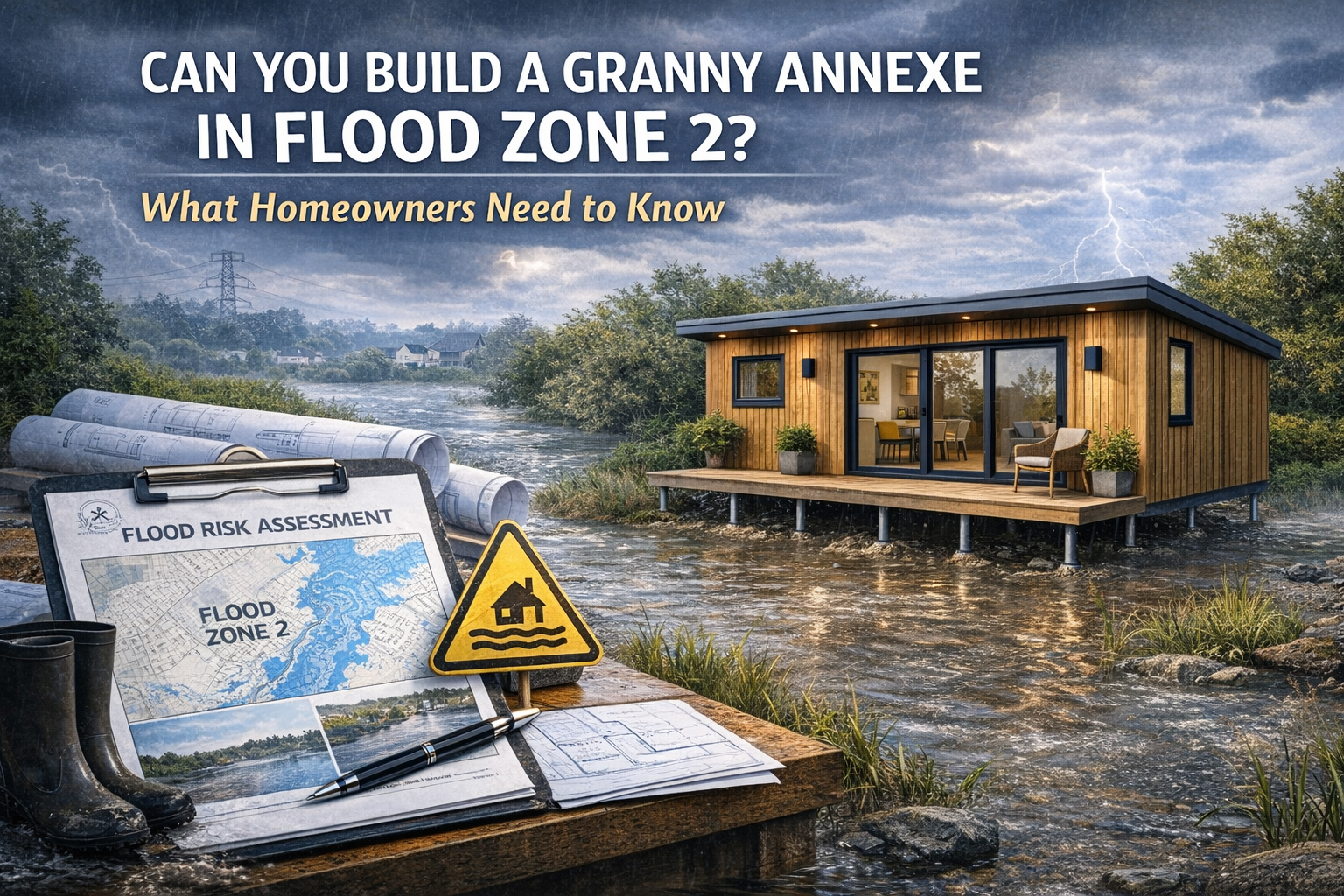
Hearing that part of your garden is in Flood Zone 2 is often enough to make a project feel uncertain before it has even begun. Many homeowners immediately assume the build will be refused, the design will have to be abandoned, or the cost will spiral before anything gets approved.
In reality, a site being in or near a flood risk area does not automatically mean you cannot build. What it usually means is that the project needs to be thought through more carefully, both in planning terms and in practical construction terms.
That is especially true with granny annexes. Unlike a basic shed or simple outbuilding, a granny annexe is designed for proper year-round use. It is a real building, intended to be safe, comfortable, insulated and durable. Once planning and flood risk come into the conversation, the design, floor level, position and foundation system all start to matter.
What does Flood Zone 2 actually mean?
Flood Zone 2 generally means land that has a medium probability of river or sea flooding. For homeowners, the important thing to understand is that this is a planning and risk category, not a statement that the site floods every year or that a build is impossible.
A lot of people hear “flood zone” and think the answer is immediately no. That is not how these projects work in practice.
What matters is:
- where the building sits on the plot
- whether the whole site is affected or only part of it
- what the finished floor level will be
- whether the proposal increases flood risk elsewhere
- how the structure is designed to respond to the site conditions
- Does being in Flood Zone 2 mean you cannot build a granny annexe?
No, not necessarily.
A granny annexe can still be possible on a site affected by Flood Zone 2, but it depends on how the proposal is designed and how well the flood risk is addressed. Some sites are straightforward. Others need more care, more supporting information and a better considered layout.
This is where people often go wrong. They focus only on the fact that flood risk exists, instead of looking at how the building can be designed properly for that location.
A sensible design approach can make a big difference.
When is a Flood Risk Assessment likely to be needed?
A Flood Risk Assessment, often referred to as an FRA, is usually required where a proposed building is in an area with identified flood risk, or where the local authority wants clear evidence that the development has been properly assessed.
For a granny annexe, that may become relevant when:
- the site falls partly or fully within Flood Zone 2
- the local planning authority requests supporting flood information
- the proposal introduces a new building in an area with known flood sensitivity
- the design needs to show how risk is being managed
The purpose of an FRA is not just to tick a box. It is there to explain the actual situation on the site and show how the building responds to it.
What does a good flood-risk approach look like?
A good approach is practical, not dramatic.
It usually means looking carefully at the design and asking sensible questions early:
- Can the annexe be positioned in the lower-risk part of the plot?
- Can the finished floor level be raised?
- Can the structure sit above ground in a way that reduces risk?
- Can water move naturally without the building becoming an obstruction?
- Can the proposal avoid making flood conditions worse elsewhere?
These are the kinds of details that help turn a difficult-looking site into a workable project.
Why foundations and floor level matter
On a flood-sensitive site, the foundation approach becomes much more important than on a simple flat garden with no constraints.
This is one reason why screw pile foundations can be a very practical solution in the right circumstances. Rather than relying on a heavy ground-bearing slab, a building can be raised above the ground, creating a clear separation between the structure and the surface below.
That can help in several ways:
- it allows the building to sit above existing ground level
- it reduces the amount of heavy excavation
- it can help maintain airflow beneath the structure
- it avoids turning the whole footprint into a solid block at ground level
- it can be a cleaner and more controlled solution on difficult plots
For some flood-risk sites, that kind of raised construction approach makes a lot more sense than treating the building like a standard extension.
Why build method matters as well
The structure itself also matters.
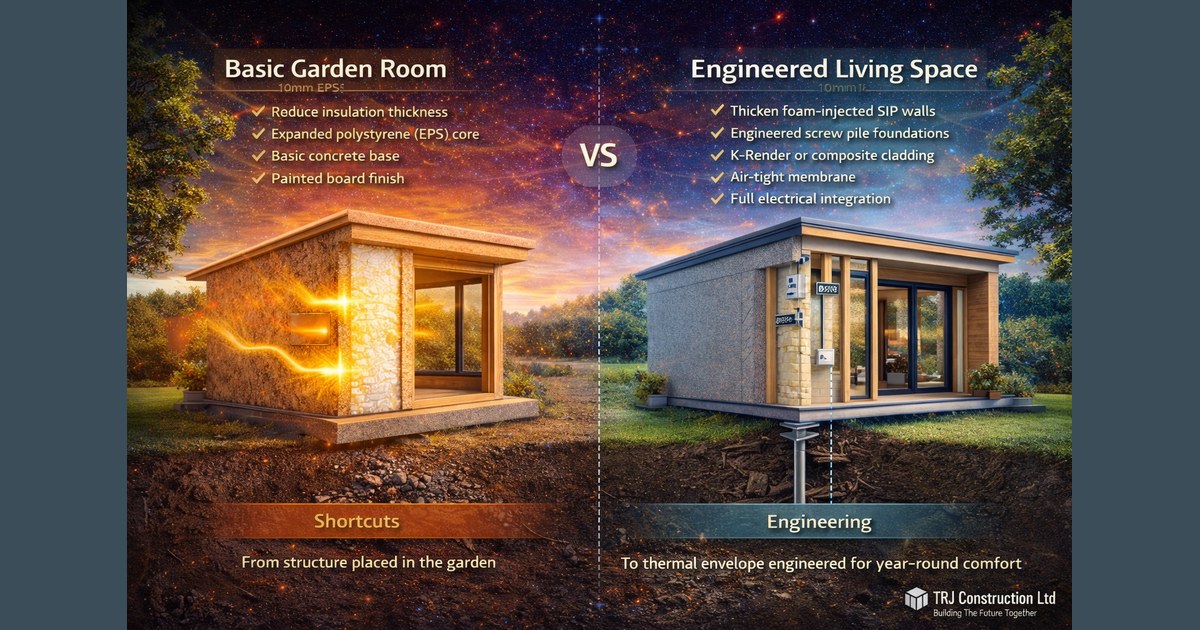
A granny annexe is not just about getting planning approval. It still has to perform properly as a living space. It needs to be warm, dry, durable and comfortable all year round. That is where high-performance construction makes a difference.
A SIP-built granny annexe can be a strong choice because it allows you to create an efficient insulated structure without turning the building into an oversized bulk on the plot. Good insulation, airtightness and build quality are still essential, even when flood-risk considerations are part of the design.
In other words, the site constraints need to be solved without compromising the standard of the building itself.
Common mistakes homeowners make on flood-risk plots
One of the biggest mistakes is assuming a flood-zone label gives a final answer before anyone has looked at the site properly.
Other common mistakes include:
- applying without understanding where the flood risk sits on the plot
- choosing the wrong part of the garden for the annexe
- not thinking about raised floor levels early enough
- treating the building like a basic garden room instead of a real annexe
- using a foundation idea that does not suit the site
- submitting poor or incomplete supporting information
In many cases, the problem is not the site alone. The problem is that the proposal has not been designed around the site conditions.
What if only part of the garden is in Flood Zone 2?
This is actually quite a common situation.
A plot may be partly affected, while another section is lower risk. In that case, the layout becomes critical. Positioning, orientation and footprint can all influence how strong the proposal is.
Sometimes the answer is not to abandon the project, but to design it better:
- place more of the building in the lower-risk section
- reduce unnecessary footprint in the affected area
- raise the structure appropriately
- keep the overall design clean and proportionate
- support the application with proper flood reasoning
That kind of approach often makes far more sense than trying to force a standard design onto a non-standard site.
Does flood risk always make the project too expensive?
Not always.
Flood-risk sites can add extra design thinking and sometimes extra professional input, but that does not automatically mean the project becomes unrealistic. In some cases, the right design decisions at the beginning can avoid bigger problems later.
The expensive route is often the wrong route:
- poor design
- weak planning support
- wrong foundation assumptions
- redesigns after objections
- avoidable delays
A better planned project can often save time, stress and money.
Final thoughts
A granny annexe on a flood-risk site is not automatically a bad idea. It is simply a project that needs to be approached properly.
If part of your garden is in Flood Zone 2, the key question is not just “Can I build?”
The better question is: “What is the right design and construction approach for this site?”
That is where practical experience matters. The layout, the floor level, the foundation system and the way the proposal is presented can all influence whether the project feels risky and problematic, or sensible and well considered.
Need help with a granny annexe on a difficult site? At TRJ Construction, we look at projects in a practical way. If your site has flood-risk concerns, level changes, awkward access or planning challenges, it is important to think about the building properly from the start.
A well-designed annexe is not just about appearance. It is about using the right construction method, the right floor level strategy and the right overall approach for the plot.
Contact
TRJ Construction to discuss your granny annexe project and get practical advice on layout, foundations and buildability before you commit to the next stage.

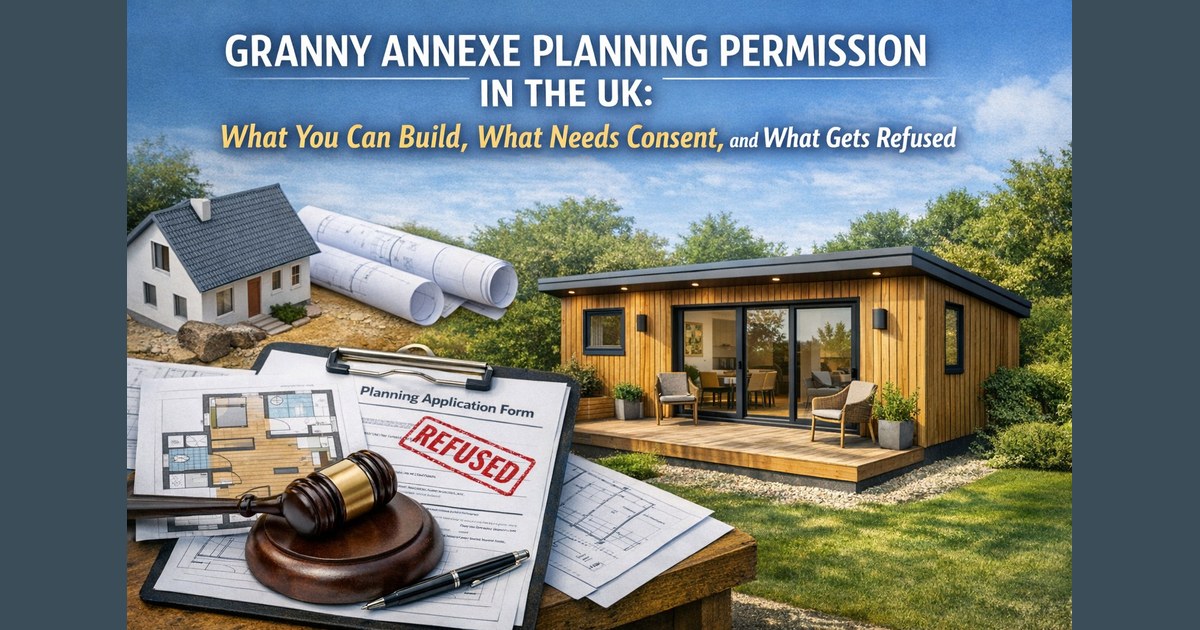
A lot of people start looking at a granny annexe with the same question: Do I need planning permission, or can I just build it? It is a fair question, because a granny annexe is not viewed in the same way as a simple shed, summerhouse or basic garden room. Once a building is designed for day-to-day living, with proper insulation, heating, a bathroom, a kitchen area and year-round use, planning becomes much more important. That is exactly why this subject deserves its own article. Your blog already covers SIP performance, airtightness, thermal comfort, structural strength, screw-pile ventilation, accessibility and broader granny annexe topics, so a dedicated planning article fills a clear gap and answers one of the biggest pre-enquiry concerns buyers have. What is a granny annexe in planning terms? A granny annexe is usually a detached building within the grounds of an existing home, designed to provide comfortable living space for a family member. In most cases, it includes proper insulation, electrics, heating, bathroom facilities and often a kitchen or kitchenette. That is where many people get caught out. From a planning point of view, the more a building looks and functions like independent living accommodation, the more likely it is that the local authority will want to assess it as a residential annexe rather than a normal outbuilding. So the real issue is not just the size of the building. It is also how it will be used. Does every granny annexe need planning permission? Not every garden building needs planning permission, but many granny annexes do. A basic outbuilding used for storage, a hobby room, a gym or a home office can sometimes fall within permitted development, depending on height, position, use and site constraints. But a granny annexe is different because it is usually intended to support actual living. That means councils often look carefully at: whether it has sleeping space whether it has a bathroom whether it has cooking facilities whether it could function as a separate dwelling whether it is clearly linked to the main house In simple terms, the closer it gets to being a self-contained home, the more likely full planning permission will be needed. When permitted development may apply There are situations where parts of an annexe-style project may sit closer to permitted development rules, especially where the building is clearly secondary to the main house and not intended as a separate dwelling. This usually works best where: the building remains incidental or ancillary to the main house it is positioned sensibly in the garden the height and scale are modest it does not create the impression of a separate residence it does not have unrestricted independent use This is where many online articles become too simplistic. They make it sound as if any building in the garden can go up without an application. In reality, once the purpose is long-term living for a family member, councils usually take a closer look. When full planning permission is usually needed Full planning permission is commonly needed where the building is intended to operate as a proper granny annexe for everyday residential use. That is often the case where the building includes: a full bedroom or sleeping arrangement a bathroom or shower room a kitchen or cooking area its own clear identity as a living unit a layout that could be occupied independently from the main house It can also be required if the site has restrictions already in place, if previous planning conditions limit outbuildings, if the property is in a sensitive location, or if the building is simply too large or too close to boundaries. Can a granny annexe have a kitchen and bathroom? Yes, it can. But this is exactly the point where planning becomes more sensitive. A shower room or bathroom is often expected in a proper annexe. A kitchen or kitchenette is also common. The issue is not whether these features are allowed in principle. The issue is whether the overall design starts to read as a fully independent dwelling rather than accommodation that remains linked to the main house. That distinction matters. A well-prepared application can still gain approval, but the design, wording and planning strategy need to be thought through properly from the start. What does “ancillary to the main house” actually mean? This is one of the most important concepts in granny annexe planning. When a building is described as ancillary, it means it supports the use of the main home rather than becoming a separate house in its own right. That usually means: family members living within the same overall household setting the building sharing the same planning identity as the main house no separate sale or separate independent occupation no intention to create a separate open-market residential unit This is where many projects succeed or fail. If the annexe is presented properly as part of the wider family home arrangement, it is often easier to justify than a building that appears to create a completely separate new dwelling in the garden. Common reasons granny annexe applications get refused Planning refusal is not always about the idea itself. Very often, it is about how the scheme is designed and presented. Some of the most common reasons include: It looks like a separate house: If the design appears too independent, the council may treat it as a new dwelling rather than an annexe. The building is too large: An oversized annexe can raise concerns about overdevelopment, scale and impact on the plot. Poor location on the site: If it dominates the garden, harms neighbour outlook, or creates privacy concerns, objections become more likely. Weak planning justification: Even a good design can struggle if the application does not clearly explain the intended family use and relationship to the main house. Access and amenity issues: Parking, access, overlooking and the effect on neighbouring properties can all become planning problems. It feels disconnected from the main home: If the building is positioned or arranged in a way that makes it feel detached in planning terms, it may be harder to argue that it is ancillary. How to improve your chances before you apply The best planning outcomes usually start long before the drawings are submitted. A better approach is to look at the project properly from day one: assess the site realistically decide how the annexe will be used keep the design proportionate to the plot think carefully about kitchen, bathroom and sleeping arrangements avoid making it look like a separate standalone house build the planning statement around family use and ancillary occupation use a layout and appearance that feel well considered, not overdeveloped This is also where experience matters. A builder who only thinks about construction cost is not enough. The project needs to work in planning terms, practical terms and long-term living terms. Why build method and design still matter ? Planning is not just paperwork. The actual specification of the building also matters. A well-designed SIP annexe can help deliver a more practical and convincing proposal because it allows you to create a high-performance building with strong insulation levels, efficient wall build-ups and a clean architectural finish without making the structure feel unnecessarily bulky. That matters for two reasons. First, the annexe needs to be a genuine comfortable living space, not a glorified summerhouse. Second, the more professional and well-resolved the proposal looks, the easier it is to present it as a serious, well-planned extension of the home rather than an improvised garden building. Your own blog already positions TRJ strongly around thermal comfort, structural strength, airtightness and high-performance SIP construction, so this planning article would connect naturally to the technical authority you have already built. The mistake many homeowners make: A lot of homeowners spend too long asking whether they can avoid planning permission altogether. That is often the wrong starting point. The better question is: What is the right route for this specific site and this specific annexe? Trying to force a residential-style annexe into the wrong category can waste months. A smarter route is to assess the site properly, decide whether permitted development is realistic, and if not, build a strong application from the beginning. A granny annexe can be one of the best ways to keep family close while creating privacy, comfort and independence. But planning permission is often the first serious hurdle, and it needs to be handled properly. There is no single answer that fits every property. The size of the plot, the position of the building, the internal layout, the intended use and the way the project is presented all make a difference. That is why a serious granny annexe should always be approached as a proper designed building, not just a garden structure with a bed and bathroom added in. Need help assessing your project? At TRJ Construction , we design and build high-performance SIP granny annexes and can help you look at the project properly from the start — from site constraints and layout thinking through to buildability, specification and the planning route. Contact us for a practical review of your granny annexe project and find out what is realistic for your site before you commit to drawings or build costs.